
Custom CNC Parts Manufacturing: Radii vs Fictiv vs Xometry (2025)
Radii offers nearshoring advantages that Fictiv and Xometry simply cannot match: a network of 200+ suppliers in Mexico, deliveries in days vs weeks from Asia, and USMCA compliance. Discover why Mexican nearshoring is the key supply chain strategy for 2025.
Custom CNC Parts Manufacturing: Radii vs Fictiv vs Xometry (2025)
Radii offers strategic nearshoring advantages that Fictiv and Xometry cannot match, with a network of 200+ audited suppliers exclusively in Mexico that guarantees predictable deliveries and lower exposure to global disruptions. While Asian supply chains face rising tariffs and geopolitical pressures, Mexican nearshoring leverages USMCA and geographic proximity to cut transit times from weeks to days, backed by 18.5 billion dollars in tax incentives from the Mexican government.
In Summary
• Unique nearshore advantage: Radii operates exclusively in Mexico with 200+ ISO 9001/AS9100 certified suppliers, while Fictiv and Xometry maintain significant dependence on Asian suppliers subject to tariff volatility
• Superior lead times: Ground shipping to the U.S. in days vs weeks from Asia, with cases like TREMEC Querétaro that reduced inspection times by 85% for parts exported to Daimler
• Exclusive tax incentives: Mexico offers accelerated deductions of 56–89% and an additional 25% on training costs, attracting 74 billion dollars across 174 relocation projects
• Competitive tolerances: ±0.005" for metals and ±0.010" for plastics under ISO 2768, matching Xometry's standards with the advantage of regional production
• Instant AI quoting: InstantQuote and FeasibilityAI analyze geometry and automatically detect manufacturing risks, competing directly with Fictiv's and Xometry's quoting engines
• Optimized USMCA compliance: Favored regional content reduces tariff barriers for exports to North America — an advantage Asian suppliers cannot offer
Custom CNC parts manufacturing has moved beyond being a purely technical process to become a strategic supply chain decision. In 2025, geographic proximity, lead times, and trade stability weigh just as much as tolerances or per-part price. Companies in automotive, aerospace, and medical sectors seek suppliers that combine precision with logistical agility — and this is where nearshoring makes the difference.
At Radii we understand that choosing between global platforms like Fictiv or Xometry is not simply a matter of comparing quotes. It means evaluating where your parts are made, how long they take to arrive, and what risks you assume along the way. This article compares all three options so you can make the best decision.
Why Does Custom CNC Parts Manufacturing Need Nearshoring in 2025?
Global supply chains have experienced unprecedented pressure due to U.S.-China trade tensions, the COVID-19 pandemic, and recent geopolitical shocks. The result has been clear: direct sourcing from China has declined, while alternatives like Vietnam and, above all, Mexico have gained share of U.S. imports.
Mexico has established itself as the preferred nearshoring platform for the U.S. and Canadian markets. BCG projects that annual trade between the United States and Mexico will increase by $315 billion by 2033, with a compound annual growth rate of 4%. This trend is driven by concrete factors:
-
Strategic location: Shared time zones with the U.S. and ground transit times measured in days, not weeks.
-
Trade agreements: USMCA favors regional content, incentivizing buyers to source North American suppliers for machined parts.
-
Skilled workforce: Mexico is a manufacturing powerhouse where the sector generates 17% of the country's jobs.
Key takeaway: Nearshoring is no longer optional for those seeking custom CNC parts with predictable deliveries and lower exposure to global disruptions.
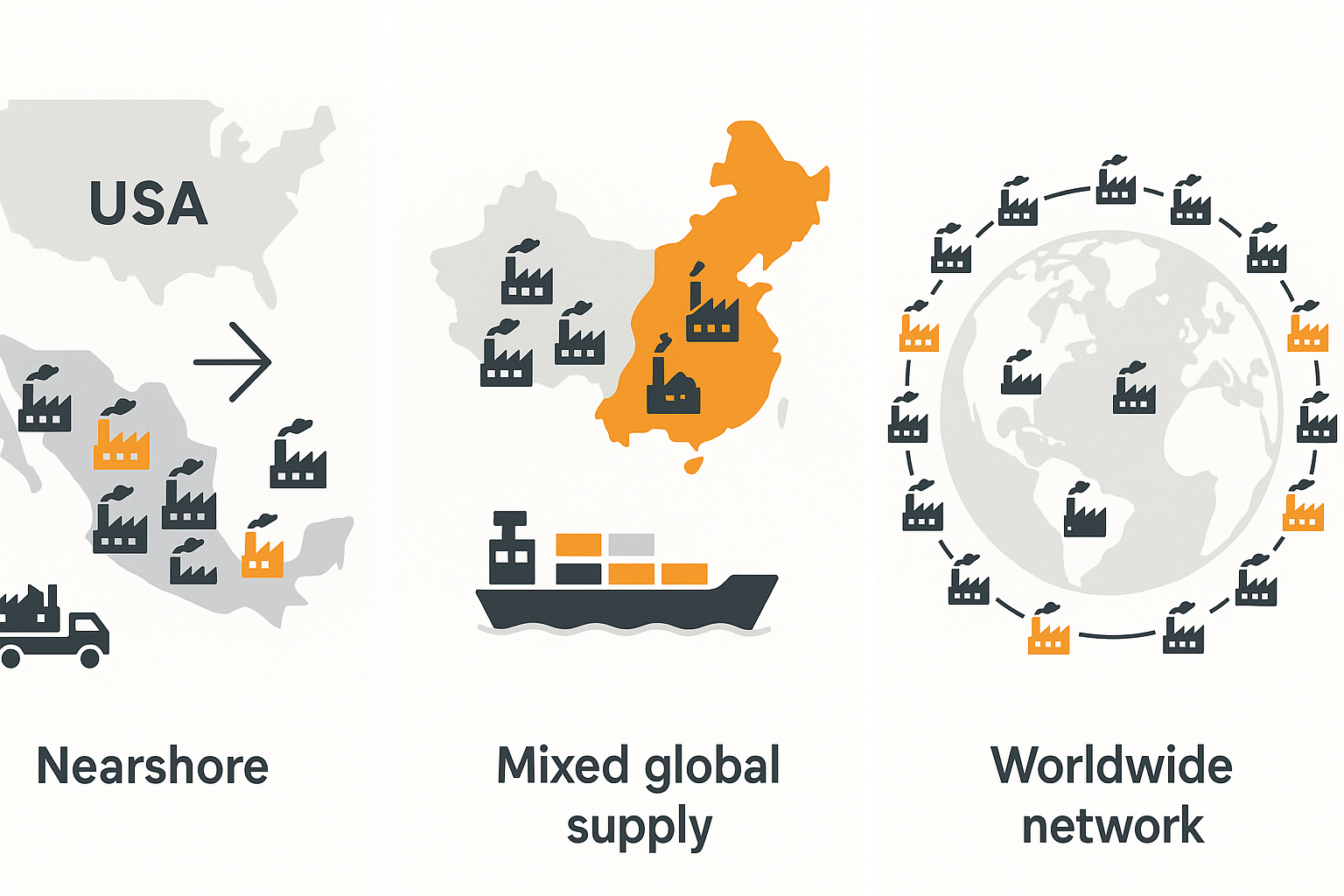
Radii, Fictiv, and Xometry Head-to-Head: Key Capabilities
All three platforms offer CNC machining, but their operating models differ significantly.
| Aspect | Radii | Fictiv | Xometry |
|---|---|---|---|
| Supplier network | 200+ audited partners in Mexico | 250 partners in U.S., China, India & Mexico | 10,000+ suppliers across 46 U.S. states and 22 countries |
| CNC tolerances — metals | ±0.005" (ISO 2768) | ISO 2768 medium class | ±0.005" (ISO 2768) |
| CNC tolerances — plastics | ±0.010" | ISO 2768 medium class | ±0.010" |
| Certifications | ISO 9001, ISO 13485, IATF 16949, AS9100D | ISO 9001, AS9100D | ISO 9001, ISO 13485, IATF 16949, AS9100D |
| Instant quoting | Yes (InstantQuote + FeasibilityAI) | Yes | Yes (Instant Quoting Engine) |
| Geographic focus | Nearshore Mexico | Global with hubs in 4 regions | Global with emphasis on U.S. and Asia |
Fictiv operates manufacturing hubs in the U.S., Mexico, India, and China, giving it geographic flexibility, though its Mexican network is limited compared to its Asian presence. Xometry, for its part, maintains a massive but globally distributed network, which can create variability in lead times depending on the assigned supplier.
Tolerances and Quality
Tolerance is the acceptable range of dimensional variation that a designer specifies based on a part's form, fit, and function. Both Xometry and Radii maintain standards of ±0.005" for metals and ±0.010" for plastics under ISO 2768.
Fictiv takes a different approach: it distinguishes between precision and accuracy. Precision refers to the ability to replicate consistent attributes across multiple units, while accuracy measures how close a measurement is to the target value. Both concepts are critical in industries such as medical devices and automotive.
For tighter tolerances (e.g., ±0.002"), costs increase due to higher scrap rates, additional tooling, and longer cycle times. In 3D printing, differences are more pronounced: FDM offers ±0.5 mm, while SLA achieves ±0.1 mm.
What Is the Strategic Advantage of Manufacturing in Mexico?
The Mexican Government has issued specific tax incentives to attract nearshoring investment. The 2024 decree has the potential to attract 18.5 billion additional dollars in investment, benefiting sectors such as auto parts manufacturing, aerospace equipment, and medical devices.
The incentives include:
-
Accelerated deduction: Companies can reduce their taxable base by between 56% and 89% within one year.
-
Training deduction: An additional 25% over three years to cover personnel training costs.
In 2023, Mexico reclaimed the top spot as the United States' primary trading partner, surpassing China after twenty years. U.S. foreign direct investment represented 38% of the total in 2023.
For the CNC industry, this translates into:
-
Specialized clusters: Querétaro leads in aerospace and automotive, with companies like Safran Landing Systems and TREMEC operating locally.
-
Simplified logistics: Ground shipments to the U.S. in days, avoiding emerging tariffs and maritime freight volatility.
-
USMCA compliance: The treaty favors regional content, reducing barriers for exporting machined parts to North America.
Total Costs and Lead Times: Which Factor Decides the Project?
Part price is only one piece of the equation. Total costs include tooling, logistics, tariffs, and the financial impact of lead times.
An analysis of manufacturing models for injection molding illustrates the differences:
-
Domestic manufacturing (U.S.): Lower shipping costs and better quality control, but tooling that is 4–5 times more expensive than offshore.
-
Offshore manufacturing (Asia): Affordable tooling, but shipping costs, tariffs, and prolonged lead times that can negate the savings.
-
Hybrid model (nearshore): Combines competitive tooling with nearby manufacturing, optimizing total cost and response time.
Fictiv offers lead times starting from 10 days for selected CNC parts, with capacity for components up to 34 feet long. However, these times vary based on the assigned manufacturing region.
Tariffs add another layer of complexity. According to the Peterson Institute, automotive tariffs could increase prices by up to $12,000 per vehicle, pressuring supply chains to seek regional options.
The Impact of Instant Quoting
Quoting speed directly affects the product development cycle. All three platforms offer instant quoting engines, but with different approaches:
Xometry: Its Instant Quoting Engine analyzes 3D models in real time, providing pricing, lead times, and DFM feedback in seconds. It is backed by multiple U.S. patents and ISO 9001:2015 and AS9100D certifications.
Fictiv: Offers instant quotes with free DFM feedback, allowing parts to be obtained in as little as one day for certain processes. Its platform uses AI to simulate 3D designs and estimate manufacturing times.
Radii: InstantQuote generates pricing in seconds, while FeasibilityAI automatically analyzes geometry and tolerances before production, detecting manufacturing risks to prevent costly errors.
"Get pricing, lead times, and design-for-manufacturing feedback in a matter of clicks, not days." — LinkedIn, Xometry
Querétaro Cluster: Real Evidence of Speed and Quality
The Querétaro industrial cluster demonstrates how nearshoring delivers tangible results. TREMEC, a Mexican transmission manufacturer headquartered in Querétaro, reduced shop-floor inspection time by 85% by implementing advanced measurement systems for parts destined for Daimler.
The data is compelling:
-
Daily production: 550–600 gears exported to Daimler's U.S. plant.
-
Inspection time: Reduced from 20 minutes to two and a half minutes per part.
-
OEM customers: Daimler, Volvo, GM, John Deere, and CNH.
TREMEC, founded in 1964, exemplifies the maturity of Mexico's manufacturing ecosystem. Its torque transfer solutions are found in supercars, high-performance sports vehicles, and heavy-duty commercial vehicles worldwide.
The Querétaro cluster also hosts Safran Landing Systems and connects with the Bajío automotive corridor, where events like EXPOMAQ bring the industry together to showcase technological advances and forge commercial relationships.
What Risks Come with Depending on Offshore Supply Chains?
Global supply chains face growing pressures that directly affect platforms with Asian dependencies.
Forced diversification by tech giants: Microsoft is seeking to have 80% of components for its Surface devices and data centers manufactured outside China by 2026. AWS is reconsidering its printed circuit board suppliers for AI data centers. Google is ramping up server production in Thailand.
Fictiv's stance on China: Despite the diversification trend, Fictiv maintains significant operations in China. "The China manufacturing base is not going away," declared Dave Evans, CEO of Fictiv, in an interview with TechCrunch. The company has grown to 60 people in Guangzhou over five years.
Tariff impact: U.S. tariffs in strategic sectors (electric vehicles, semiconductors, steel, medical components) raise domestic prices even when sourcing locally, because upstream costs propagate through the market.
For Xometry and Fictiv, whose networks span multiple continents, geographic variability can translate into unpredictable lead times and exposure to trade disruptions. Radii, with an exclusive focus on Mexico, offers a lower-risk alternative for North American customers.
Conclusion and Next Steps
The choice between Radii, Fictiv, and Xometry depends on your priorities: global reach vs regional stability, price vs lead time, process variety vs specialization.
The TREMEC case in Querétaro demonstrates that Mexican manufacturing competes in precision and efficiency with any global alternative. With an 85% reduction in inspection times and daily exports to U.S. OEMs, nearshoring is not a gamble — it is a proven strategy.
Do you have a project in mind? At Radii we combine instant quoting with an audited network of suppliers in Mexico, offering tolerances of ±0.005" and deliveries that leverage the geographic advantage of nearshoring. Transforming your supply chain is easier and faster than you think.
Why Radii for Companies in Mexico?
If your company operates in Mexico and needs high-precision parts, Radii offers advantages that global platforms cannot provide:
- Instant quoting: upload your CAD and receive pricing and feasibility analysis in minutes. Traditional machine shops take days.
- Real lead times: network of 200+ shops in Mexico. No international transit times, no customs.
- Competitive pricing: no global intermediary markups.
- Local certifications: IATF 16949 for automotive and AS9100 for aerospace. Your suppliers are already audited.
FAQ
Why is nearshoring important in CNC manufacturing in 2025?
Nearshoring is crucial due to trade tensions and the need for fast deliveries. Mexico offers advantages such as geographic proximity and trade agreements that favor regional content, reducing risks and lead times.
What are the key differences between Radii, Fictiv, and Xometry?
Radii focuses on nearshoring in Mexico with an audited supplier network, while Fictiv and Xometry have global networks. Radii offers more predictable deliveries and lower exposure to geopolitical disruptions.
What advantages does Radii offer compared to Fictiv and Xometry?
Radii offers nearshoring advantages such as faster lead times and lower tariff exposure. Its focus on Mexico enables integrated management and single-point accountability in the supply chain.
How does geographic location affect lead times in CNC manufacturing?
Geographic location influences lead times through proximity to the target market. Nearshoring in Mexico enables shorter transit times and fewer risks from global disruptions, compared to Asian suppliers.
What impact do tariffs have on CNC manufacturing?
Tariffs can significantly increase production costs and affect competitiveness. Nearshoring in Mexico helps mitigate these costs by leveraging treaties like USMCA, which favor regional content.
Sources
- https://www.bcg.com/publications/2025/great-powers-geopolitics-global-trade
- https://www.gob.mx/shcp/prensa/comunicado-no-68-gobierno-de-mexico-fortalece-inversiones-por-nearshoring-en-todo-el-pais
- https://www.renishaw.com/en/tremec-mexico-reduces-shop-floor-gauging-time-of-daimler-parts-by-85-with-equator-gauges--39080
- https://www.nber.org/papers/w31661
- https://www.bbva.mx/educacion-financiera/empresa/oportunidades-de-nearshoring-y-smartshoring.html
- https://www.xometry.com/capabilities/cnc-machining-service/
- https://www.fictiv.com/articles/how-to-cut-cnc-machining-costs
- https://xometry.com/resources/machining/what-every-designer-needs-to-know-about-cnc-part-tolerances
- https://www.fictiv.com/articles/precision-cnc-machining-how-can-you-make-your-parts-more-precise
- https://xometry.pro/en/articles/3d-printing-tolerances/
- https://gamas.com.mx/importancia-nearshoring-mexico
- https://sinoextrud.com/cnc-machining-mexico/
- https://www.echosupply.com/blog/injection-molding-pricing-domestic-vs-offshore-vs-hybrid/
- https://www.prnewswire.com/news-releases/fictiv-launches-large-scale-cnc-parts-manufacturing-302479215.html
- https://techcrunch.com/2025/03/05/trump-gives-automakers-one-month-tariff-reprieve-to-move-operations-from-canada-mexico-to-us/
- https://www.xometry.com/quoting/home/
- https://www.fictiv.com/articles/us-machine-shops-supply-demand
- https://www.linkedin.com/products/xometry-the-instant-quoting-engine%C2%AE/
- https://en.wikipedia.org/wiki/TREMEC_Corporation
- https://techcrunch.com/2025/10/16/microsoft-aws-and-google-are-trying-to-drastically-reduce-chinas-role-in-their-supply-chains/
- https://techcrunch.com/2022/11/11/why-digital-sourcing-platform-fictiv-stays-in-china-when-others-are-leaving/